
By Bill Gerardi, Chief Medical Officer, Medecision
By January 1, 2027, impacted health plans will be focused on a familiar milestone: technical compliance with the CMS Interoperability and Prior Authorization Final Rule, CMS-0057-F. The APIs will be live. Prior authorization. Provider Access. Payer-to-Payer.
But the question I keep hearing from health plan leaders is different: Will we be compliant on paper—or ready in practice? Those are not the same thing.
If I were running operations at a health plan today, I would spend less time asking whether the API will technically work and more time asking whether the organization can absorb what happens when it does.
The API that should worry you more than ePA
Much of the CMS-0057-F conversation has understandably focused on electronic prior authorization. Prior authorization has been a visible source of friction for years, and the operational provisions already in effect—including the 72-hour and 7-day decision timeframes and specific denial-reason requirements—have forced meaningful change.
But the Payer-to-Payer API presents a different kind of challenge. With member consent, a new plan can request historical information from a member’s previous plan shortly after coverage begins.
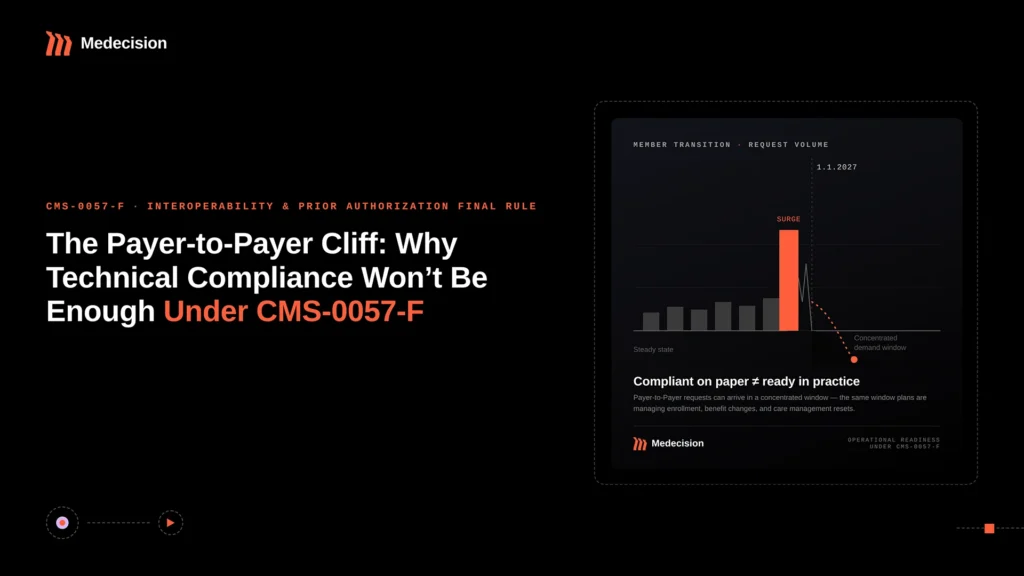
Now consider what happens when large numbers of members change coverage around the same time. Payer-to-Payer requests can arrive in a concentrated window, at the same time health plans are managing enrollment, benefit changes, care-management activity, provider inquiries, and other plan-year resets.
This is not a steady-state integration problem. It is a Payer-to-Payer cliff.
The risk is not simply whether systems can handle the transaction. The risk is whether the organization can absorb the operational consequences when demand arrives in a concentrated window. A plan can be technically compliant and still be operationally overwhelmed.
Testing readiness has not caught up to the deadline
The second issue I hear consistently is testing. Proactive testing between payers and their trading partners is not yet where it needs to be. There is a need for greater industry coordination around testing directories, success criteria, and consent-related risk.
Health plans are right to want more clarity from CMS and ONC. A standardized approach to testing would help de-risk the last mile of implementation, particularly when readiness depends on multiple organizations moving in sync. A grace period specifically for testing may be a reasonable industry request.
But no health plan should build its operating strategy around the assumption that additional time will materialize. The deadline as written is the deadline to plan against.
Add to that a market where portions of the payer technology ecosystem are experiencing significant capacity constraints, and waiting becomes increasingly difficult to recover from.
What does “ready” actually require?
Operational readiness rests on three capabilities: Unified data. Event-driven infrastructure. Governed automation.
1. Unified data—not data assembled on demand
A surge of Payer-to-Payer requests is only manageable if claims, clinical, pharmacy, and prior authorization information can be accessed through a coherent, longitudinal view of the member. The question is not whether the data exists somewhere in the enterprise. The question is whether it can be made available quickly enough, completely enough, and in the right context to support the workflow when the request arrives. A dozen disconnected source systems may contain the information. That does not mean the organization is operationally ready to use it.
2. Event-driven infrastructure—not batch processing
When coverage begins and a data request arrives, the response needs to be driven by the event. It cannot depend on information sitting in a nightly batch queue while clinical and operational teams wait. Event-driven architecture allows an organization to absorb a concentrated demand spike rather than allowing that spike to become a backlog. That distinction becomes particularly important when the volume is concentrated into days rather than distributed evenly across the year.
3. Governed automation—not automation without accountability
As more of this workflow becomes automated, governance becomes more important—not less. Clinical and compliance leaders need to know: What did the system do? Why did it do it? What data did it use? What consent was established? Can the decision or transaction be reconstructed later? Automation without explainability and auditability creates a new risk while attempting to solve an old one.
Technology and change management have to come together
Infrastructure creates the capability. Change management determines whether the organization can operationalize it. That means aligning technology with clinical workflows, governance, workforce readiness, testing, escalation, and accountability.
A technically elegant solution can still fail if the people operating it do not understand what changes, what actions are expected, and when an issue needs to be escalated. That is why CMS-0057-F should be viewed as more than an API implementation. It is an operating-model change.
What independent validation tells us
Independent industry recognition provides useful validation of the capabilities required to operate in this environment.
Frost & Sullivan named Medecision an Innovator in its 2026 Frost Radar for U.S. Population Health Management, highlighting capabilities including real-time data activation, FHIR-based interoperability, and approaches to AI governance and auditability.
Black Book Research reported #1 ratings for Medecision in 14 of 18 criteria in its 2026 payer IT evaluation, including Care Management, LTSS, and Complex Care Coordination.
The broader point is not the awards themselves. It is that capabilities such as real-time orchestration, interoperability, longitudinal data, and governed automation are becoming increasingly important as health plans operate under more complex regulatory and clinical requirements.
Compliance is the floor, not the finish line
I have long viewed interoperability requirements like CMS-0057-F as more than mandates. They are opportunities to improve how health plans understand and act on member information.
Organizations that get the infrastructure right can come out of this transition with more than technical compliance. They can have cleaner longitudinal data, stronger clinical workflows, better provider connectivity, and an infrastructure foundation that can adapt to whatever regulatory requirement comes next.
But technology alone will not get them there. Strategy alone will not get them there either. Health plans need the infrastructure to move and orchestrate the data—and the organizational capability to act on it.
That is where Medecision and Excell Healthcare Advisors come together: technology and clinical innovation paired with the governance, operating-model transformation, and change management required to put that technology into practice.
The question leaders should be asking now
The question is no longer: “Will we be compliant?”
It is: “Can we operate at scale when compliance becomes reality?”
That is the difference between having an API and being ready for what happens when the API works. Compliance is the floor. Readiness is the competitive advantage.